

How Data Is Transforming Healthcare Decision-Making: A 2026 Guide for Leaders
The shift toward data healthcare decision making is reshaping how hospitals, clinics, and staffing agencies operate. For decades, clinical choices relied heavily on physician intuition, anecdotal experience, and tradition-bound protocols. That era is ending. Today, healthcare organizations that fail to embed data into every layer of decision-making risk falling behind clinically, operationally, and financially. This guide provides a clear framework for understanding how data transforms healthcare decisions, where the real return on investment lives, and what it takes to implement these systems successfully.
What Is Data-Driven Decision-Making in Healthcare?
Data-driven decision-making in healthcare is the systematic use of quantitative and qualitative information to guide clinical, operational, and strategic choices. Rather than relying solely on a clinician's personal experience or a department's historical habits, DDDM pulls from electronic health records, lab results, claims data, patient-reported outcomes, wearable device streams, and even supply chain logs to inform what happens next.
The scale of available data has exploded. Before the pandemic, researchers calculated that the average patient generated roughly 80 megabytes of health data per year. That figure has since been surpassed, driven by telehealth adoption, remote monitoring, and genomic testing. Yet a striking 47 percent of healthcare data remains underutilized in decision-making, according to research cited by Arcadia.io. That gap represents both a missed opportunity and a competitive risk. For administrators, clinical leaders, and health IT professionals, closing that gap means better patient outcomes, tighter operations, and stronger financial performance.
The Four Pillars of Healthcare Analytics
Understanding data healthcare decision making requires knowing what questions each type of analytics can answer. Most frameworks break healthcare analytics into four categories, each building on the one before it.
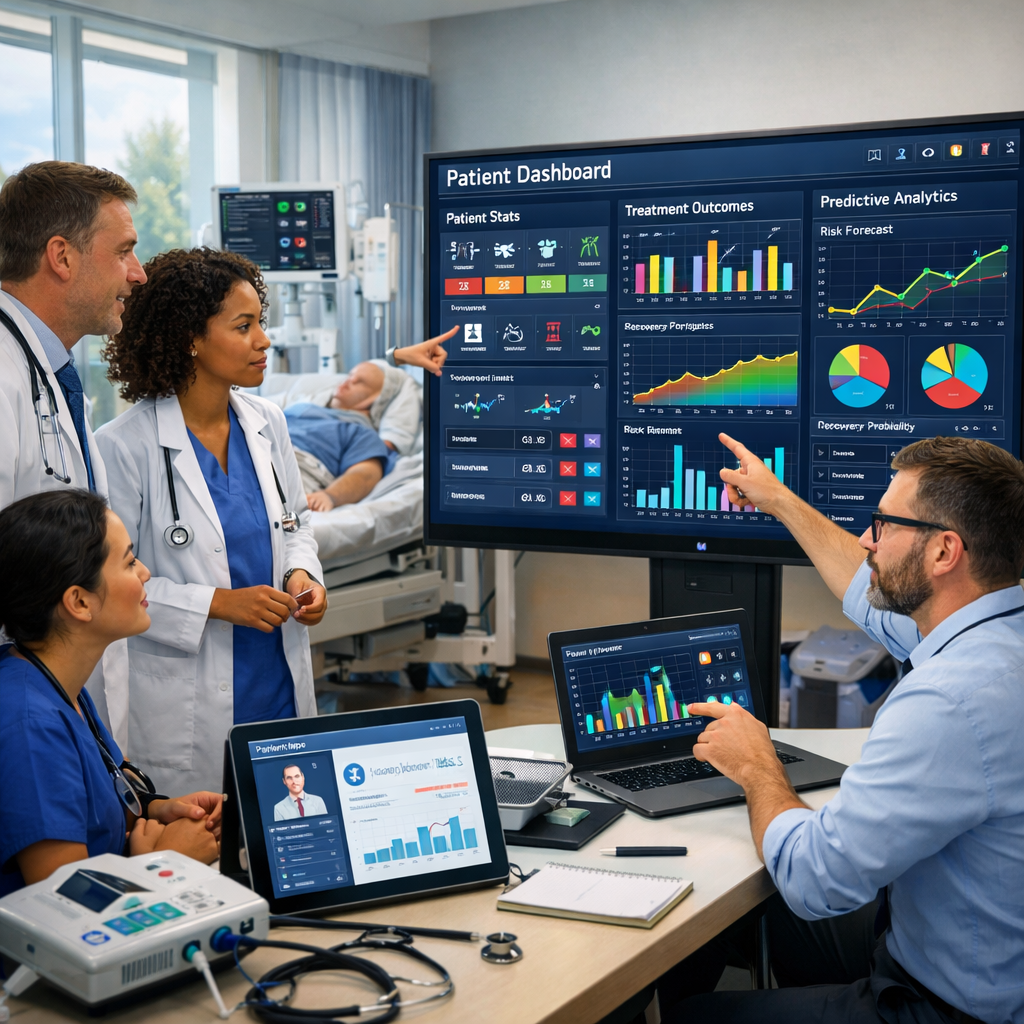
Descriptive analytics answers the question: what happened? This is the foundation. Hospitals use descriptive analytics to track historical patient volumes, readmission rates, average length of stay, and infection incidence. Dashboards showing last month's emergency department visits or last quarter's surgical complication rates fall into this bucket. Without descriptive analytics, organizations cannot establish baselines or spot trends.
Diagnostic analytics goes deeper, asking: why did it happen? When a hospital sees a spike in central line-associated bloodstream infections, diagnostic analytics helps trace the root cause. It might reveal that a specific unit changed suppliers, that staffing ratios shifted on certain shifts, or that a batch of catheters was linked to the outbreak. This layer moves organizations from observing problems to understanding their origins.
Predictive analytics asks: what will happen? This is where machine learning models enter the picture, forecasting patient admissions, identifying individuals at high risk for readmission, or flagging patients likely to deteriorate within the next 24 hours. The market is responding accordingly. Global predictive analytics revenues are projected to reach $22 billion by 2026, signaling how rapidly healthcare organizations are investing in this capability.
Prescriptive analytics takes the final step, asking: what should we do? These systems recommend specific actions, such as optimal treatment pathways for a patient with multiple chronic conditions or ideal staffing levels for a nursing unit based on predicted acuity. Prescriptive analytics closes the loop from insight to action, though it demands the highest level of data maturity and clinician trust.
Key Applications of Data Healthcare Decision Making
Personalized Treatment Plans and Precision Medicine
One of the most compelling applications of data healthcare decision making lives in personalizing care. Research from Dartmouth, presented through the Harvard CHDS seminar series, found that treatment plans incorporating both clinical information and genetic testing improve health outcomes and reduce costs compared to plans using clinical information alone. A concrete example involves cholesterol management. By analyzing genetic markers alongside traditional risk factors, clinicians can determine whether a patient needs a statin, a PCSK9 inhibitor, or a different approach entirely, avoiding trial-and-error prescribing that wastes time and money.
Deep learning is accelerating this shift. A 2025 study published in PMC reports that deep learning models are being harnessed to optimize decision support, diagnosis, and treatment strategies, with researchers documenting applications across oncology, cardiology, and neurology. These models can analyze imaging, pathology slides, and genomic data simultaneously, surfacing patterns no human clinician would detect.
Reducing Readmissions and Managing Chronic Disease
Predictive models now routinely flag patients at risk of 30-day readmission before they leave the hospital. By analyzing variables such as comorbidities, social determinants of health, medication adherence history, and prior utilization patterns, these tools give care teams a window to intervene with targeted discharge planning, follow-up calls, or home health referrals.
Cardiovascular disease management has seen particularly strong results, with predictive analytics identifying patients whose conditions are likely to worsen without medication adjustments or lifestyle interventions. In the opioid use disorder space, research from Harvard CHDS highlights how incorporating disparity considerations into funding allocation models can direct resources to communities most in need, rather than distributing funds based on population counts alone.
Wearable data adds another dimension. Smartwatches and fitness trackers are being used to monitor anxiety, depression, and burnout among medical trainees, offering a continuous stream of physiological data that self-reported surveys cannot match. This same approach is expanding into chronic disease management, where remote monitoring of glucose levels, blood pressure, and heart rhythm feeds directly into clinical decision engines.
Operational Efficiency and Supply Chain Optimization
Clinical decisions capture most of the attention, but operational applications of data healthcare decision making deliver some of the fastest returns. Supply chain management offers a prime example. Data-driven value analysis helps hospitals make smarter purchasing decisions, manage recalls efficiently, and evaluate substitution options when preferred products are unavailable. When a supplier issues a recall, analytics tools can identify every affected item across the system in seconds rather than days.
Staffing is another high-impact area. Predictive scheduling models forecast patient volumes and acuity levels, allowing hospitals to align nurse and physician schedules with expected demand. This reduces both understaffing, which drives burnout and turnover, and overstaffing, which inflates labor costs. For organizations working with staffing agencies, these models also reduce reliance on expensive last-minute contract labor.
Organ transplantation represents a highly specialized but powerful application. Machine learning approaches are now predicting deceased donor organ yield, helping transplant centers make faster, more accurate decisions about organ acceptance. Given the time-sensitive nature of transplantation, these models directly affect how many viable organs reach patients on waiting lists.
The Real ROI of Data-Driven Healthcare
Most discussions of data healthcare decision making describe benefits in qualitative terms. The financial case, however, is equally important and often underreported. Organizations that invest in analytics see returns through multiple channels.
Fewer unnecessary tests and shorter hospital stays generate immediate savings. When predictive models identify low-risk patients who can safely be discharged earlier, or when diagnostic analytics reduce duplicate imaging orders, the cost reductions flow directly to the bottom line. Revenue cycle management improves through predictive billing models that flag claims likely to be denied before submission, allowing correction upfront rather than chasing payments later.
The personalized treatment example from Dartmouth carries a direct financial implication. Genetic testing for cholesterol treatment costs money upfront but saves far more by preventing adverse cardiac events and avoiding ineffective medication trials. One analysis found that incorporating genetic data into treatment planning reduced total care costs by steering patients to the right therapy the first time.
Staffing ROI deserves particular attention. Better data leads to lower turnover, which reduces recruitment costs, orientation expenses, and the productivity losses that come with constant churn. For hospitals that rely on agency staff to fill gaps, predictive scheduling can cut agency spend substantially by reducing the frequency of last-minute openings. Healthcare Staffing Plus and similar partners help organizations bridge the gap between analytics insights and actual staffing execution, ensuring that data-driven plans translate into filled shifts with qualified clinicians.
Overcoming the Top 5 Implementation Challenges
Data Quality and Integration
Siloed systems remain the single largest technical barrier to effective data healthcare decision making. Electronic health records, billing platforms, laboratory information systems, and pharmacy databases often operate as separate fiefdoms, creating fragmented views of the same patient. Without interoperability standards and clean data governance, analytics outputs are unreliable. Organizations must invest in data normalization, master patient indexing, and interface engineering before predictive models can deliver on their promise.
Privacy, Security, and Regulatory Compliance
HIPAA compliance provides the baseline for patient data protection, but the regulatory landscape extends further. The FDA is increasingly involved in regulating AI-assisted diagnostic tools, particularly those that make clinical recommendations without human intermediation. Legal liability questions remain unsettled. When an algorithm recommends a treatment that fails, responsibility could fall on the clinician who followed the recommendation, the hospital that deployed the tool, or the vendor that built it. Healthcare leaders need legal counsel familiar with emerging AI liability frameworks before adopting high-stakes decision support systems.
Clinician Buy-In and Data Literacy
Resistance to data-driven recommendations often stems from legitimate concerns. Clinicians who have spent years developing diagnostic instincts may view algorithmic suggestions as a black box they cannot interrogate or trust. Overcoming this requires more than a one-time training session. Organizations need structured change management programs that teach data literacy as a clinical skill, not an IT competency. Building a culture of curiosity, where clinicians are encouraged to question model outputs and contribute their own insights back into system improvement, proves far more effective than mandating compliance with dashboard metrics.
Special Population Considerations
Pediatric and geriatric populations present distinct modeling challenges that generic analytics platforms often overlook. Children are not simply small adults. Their normal ranges for vital signs, lab values, and developmental milestones differ fundamentally. Geriatric patients, meanwhile, carry complex comorbidity profiles and polypharmacy risks that require specialized algorithms. Applying models trained on general adult populations to these groups can produce misleading or dangerous recommendations. Organizations serving these populations must validate that their analytics tools are built on appropriate data sets.
Addressing disparities in funding allocation represents another dimension of this challenge. The opioid use disorder research from Harvard demonstrates that equity-blind allocation models can perpetuate or worsen treatment gaps. Data-driven decision-making must actively incorporate disparity considerations rather than assuming that optimizing for aggregate outcomes will benefit all groups equally.
Tool Selection and Vendor Comparison
The analytics platform market is crowded and confusing. Organizations evaluating options should prioritize EHR integration depth, real-time dashboard capabilities, and the sophistication of predictive modeling features. A platform that cannot pull live data from the EHR or requires extensive manual data entry will fail regardless of its analytical power. Vendor stability, user experience for clinical staff, and the availability of implementation support all matter as much as algorithmic performance. This section is not a product review, but the principle holds: buy for usability and integration first, advanced features second.
The Future of Data Healthcare Decision Making
Deep learning and AI will continue their march from diagnostic support toward autonomous decision-making in low-risk scenarios. Regulatory frameworks from the FDA and the Office of the National Coordinator for Health IT will evolve to keep pace, though likely more slowly than the technology itself. Wearable and remote monitoring data will become standard inputs for clinical decisions rather than experimental add-ons. Data literacy will shift from a specialized skill to a core competency for every healthcare professional, reshaping medical education and continuing education requirements alike. The ultimate goal remains a learning health system where every patient encounter generates data that improves the next decision, creating a continuous cycle of insight and improvement.
Frequently Asked Questions About Data in Healthcare Decision-Making
What is the difference between data-driven and evidence-based decision-making? Evidence-based practice relies on published research and clinical trials, while data-driven decision-making incorporates real-time organizational data alongside that evidence. The two approaches complement each other rather than competing.
How is big data different from traditional healthcare data? Big data encompasses the volume, velocity, and variety of information now available, including unstructured notes, imaging, genomic sequences, and streaming device data. Traditional healthcare data typically refers to structured information within EHRs and claims systems.
What are the biggest risks of relying on data for clinical decisions? Algorithmic bias, data quality issues, and over-reliance on model outputs without clinical judgment top the list. Models trained on biased historical data can perpetuate or amplify disparities.
How can small hospitals or clinics afford data analytics tools? Cloud-based platforms with subscription pricing have lowered barriers significantly. Some regional health information exchanges also offer shared analytics services to member organizations.
What role does artificial intelligence play in healthcare decision-making? AI powers the predictive and prescriptive analytics that identify patterns and recommend actions. It augments rather than replaces human judgment in most current applications.
Key Takeaways for Healthcare Leaders
Data is a strategic asset, and underutilization is a competitive risk that grows each year. Organizations should start with descriptive and diagnostic analytics before investing heavily in predictive models, building both technical infrastructure and staff confidence along the way. Data literacy and clinician buy-in deserve as much attention as technology investments. Measure ROI in both clinical outcomes and financial terms to sustain executive support. Partner with staffing and analytics experts who can bridge the talent gap while internal capabilities mature.