


How Healthcare Technology Improves Patient Outcomes: A 2026 Guide
In a $2 trillion industry often bogged down by red tape and crushing administrative costs, healthcare technology is emerging as the primary lever for improving patient outcomes across the United States. The term encompasses far more than flashy gadgets or software upgrades. It refers to the integrated ecosystem of electronic health records, artificial intelligence, robotic surgical systems, wearable devices, and telehealth platforms that are fundamentally reshaping how care is delivered, monitored, and refined. Consider a thought experiment posed by researcher Harold Thimbleby: a 19th-century nurse transported to a modern hospital would find the culture of medicine eerily familiar, with its hierarchies and rituals, but would be utterly bewildered by the infusion pumps, MRI scanners, and implantable defibrillators surrounding her. The technology has sprinted ahead while human systems have struggled to keep pace. This guide examines the specific technologies driving better survival rates, faster recoveries, and improved quality of life, along with the very real obstacles that stand between promise and practice.
The Core Pillars of Modern Healthcare Technology
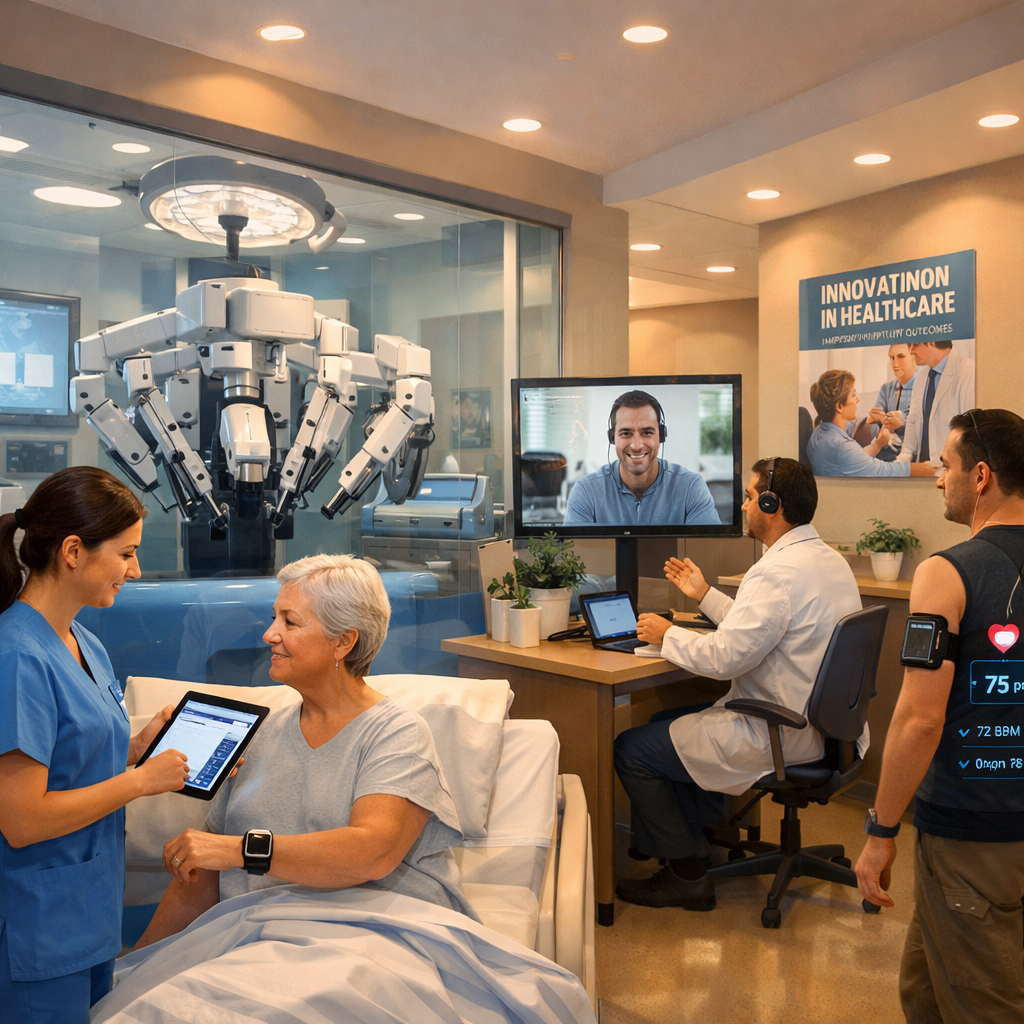
Modern healthcare technology is not a collection of standalone tools but an interconnected ecosystem designed to shift medicine from a reactive discipline to a proactive one. The core pillars include electronic health records serving as the digital backbone, artificial intelligence and machine learning powering diagnostic insights, telehealth platforms extending care beyond clinic walls, wearable sensors generating continuous physiological data, and robotic systems enhancing surgical precision. These technologies feed into one another: a wearable device detects an irregularity, the data flows into an EHR, an AI algorithm flags the anomaly, and a telehealth consult brings the patient and specialist together without delay. The Centers for Medicare and Medicaid Services has formally called on data networks, EHR developers, and health app creators to participate in a unified Health Technology Ecosystem, signaling that interoperability is now a national priority. Looking ahead, the concept of the digital twin, a virtual replica of a patient's organs used to simulate treatments before they are performed, represents the cutting edge of predictive diagnostics and is already being identified as a top trend for 2026 by industry leaders like Medtronic.
AI and Machine Learning in Diagnostics
Artificial intelligence has moved beyond theoretical promise and into clinical practice, particularly in the realm of medical imaging. Algorithms trained on millions of annotated X-rays, MRIs, and CT scans can now detect malignancies, neurological abnormalities, and cardiovascular anomalies with speed and accuracy that rival or exceed human radiologists. In mammography, AI-assisted reading has demonstrably reduced false positive rates, sparing thousands of women the anxiety, expense, and physical discomfort of unnecessary biopsies. The technology excels at pattern recognition at scales the human eye cannot match, identifying microcalcifications and subtle tissue distortions that might otherwise go unnoticed. Beyond imaging, predictive analytics tools ingest patient data, lab values, vital signs, and historical records to forecast clinical deterioration before symptoms manifest. Hospitals deploying these systems have seen earlier interventions for sepsis, heart failure decompensation, and stroke risk, conditions where hours or even minutes determine the trajectory of recovery. The shift is profound: rather than waiting for a patient to crash, care teams receive actionable alerts that allow them to intervene when treatment is most effective and least invasive.
Telemedicine and Remote Patient Monitoring
Telehealth has matured into a sophisticated care delivery model built on four distinct functions: live video consultations, store-and-forward transmission of images and data, remote patient monitoring, and mobile health applications. The impact on chronic disease management has been particularly striking. Diabetic patients enrolled in remote monitoring programs, where glucose readings are transmitted continuously to care teams who adjust medications and provide real-time coaching, consistently achieve lower hemoglobin A1c levels than those relying on quarterly office visits alone. The continuous feedback loop closes the gap between clinical encounters and daily life, where health decisions actually happen. For post-surgical patients, remote monitoring has proven effective at reducing hospital readmissions. A patient recovering from joint replacement or cardiac surgery can have vital signs, wound images, and mobility data reviewed daily, allowing care teams to catch infections, fluid buildup, or arrhythmias before they escalate into emergencies. In rural America, where specialist shortages are acute and travel distances to tertiary centers can stretch for hours, telehealth has become a lifeline. A stroke patient in a critical access hospital can be evaluated by a neurologist via video within minutes, receiving thrombolytic therapy that prevents permanent brain damage, an outcome simply impossible a decade ago.
Surgical Precision and Recovery: Robotics and Minimally Invasive Tech
The robotic-assisted surgery market has grown steadily over the past decade, with analysts projecting a compound annual growth rate of nearly 11 percent. The volume of robotic procedures performed each year has risen sharply, particularly in gynecological, cardiothoracic, and colorectal surgeries. The benefits to patients are tangible and well-documented. Robotic platforms enable surgeons to operate through incisions measured in millimeters rather than inches, resulting in less intraoperative blood loss, reduced postoperative pain, shorter hospital stays, and markedly faster returns to normal activity. A patient who once faced a week in the hospital and six weeks of restricted movement after open abdominal surgery may now go home in two days and resume light activity within a fortnight. The technology achieves this through several mechanisms. Three-dimensional high-definition visualization gives the surgeon depth perception and magnification far beyond the naked eye. Tremor filtration software eliminates the micro-shakes inherent in human hands, allowing for delicate maneuvers near critical nerves and vessels. Articulated instruments with wrist-like dexterity can navigate tight anatomical spaces that rigid laparoscopic tools cannot reach. The industry trend toward less invasive surgery continues to accelerate, with Medtronic and other device manufacturers investing heavily in platforms that further shrink the physical footprint of major procedures. The goal is clear: transform surgeries that once required large open exposures into outpatient or short-stay events with equivalent or superior clinical outcomes.
Wearables and the Rise of Patient-Generated Health Data
The consumer wearable market has evolved from simple step counters into a sophisticated health monitoring infrastructure. Smartwatches now track heart rate, blood oxygen saturation, sleep architecture, and even electrocardiogram readings. Continuous glucose monitors have liberated diabetic patients from multiple daily finger sticks while providing granular data on glycemic patterns. Embedded sensors in clothing can measure respiratory rate, posture, and gait. This flood of patient-generated health data represents both an opportunity and a challenge. On the opportunity side, real-time vital sign data empowers patients to understand their bodies and take ownership of their health in ways previously reserved for elite athletes or the seriously ill. The clinical impact is already evident. Emergency departments and cardiology clinics have reported cases where Apple Watch atrial fibrillation alerts prompted patients to seek evaluation, leading to the diagnosis of paroxysmal arrhythmias that might otherwise have gone undetected until a stroke occurred. These are life-saving interventions triggered by consumer technology. The challenge lies in translation. A continuous stream of heart rate variability data or sleep stage percentages means little to a busy primary care physician with fifteen minutes per patient. The industry must develop filtering, summarization, and alerting systems that surface clinically relevant anomalies without drowning clinicians in noise. The raw data must become actionable insight, or it risks becoming a burden rather than a benefit.
Addressing the Gaps: Challenges to Adoption
The path from technological capability to widespread clinical adoption is littered with obstacles that receive far less attention than the innovations themselves. Cybersecurity and patient privacy represent the most urgent concern. Healthcare data breaches have exposed the protected health information of millions of Americans, eroding the trust that digital health tools depend upon. Every connected device, from an MRI scanner to a patient's smartphone, represents a potential entry point for ransomware attacks that can paralyze hospital operations and endanger lives. HIPAA compliance is non-negotiable, but the regulatory framework struggles to keep pace with the velocity of technological change. Interoperability remains a stubborn barrier. The vision of a seamless Health Technology Ecosystem promoted by CMS crashes against the reality of proprietary EHR systems that do not communicate with one another, imaging archives that cannot share data across health systems, and wearable platforms that export data in incompatible formats. The HL7 FHIR standard has made progress, but a patient who visits a specialist, a hospital, and a pharmacy in the same week may still find that none of the three have access to the full clinical picture. Fragmented data produces fragmented care, and fragmented care produces worse outcomes. Health equity concerns demand attention as well. The populations that stand to benefit most from remote monitoring and telehealth, rural, low-income, elderly, and chronically ill patients, are often the least likely to have reliable broadband access, digital literacy, or the financial means to purchase connected devices. Without deliberate design and policy intervention, healthcare technology risks widening the very disparities it could help close. Finally, the human factor cannot be ignored. Implementing new technology without adequate training, without adjusting workflows, and without addressing the staffing shortages that already drive clinician burnout leads to resistance, workarounds, and abandonment. Technology imposed on exhausted people becomes another stressor, not a solution.
Regulatory Hurdles and ROI
The regulatory landscape for healthcare technology presents a fundamental tension between speed and safety. AI diagnostic algorithms require FDA clearance, a process designed for hardware devices that change slowly, not software that iterates monthly. By the time an algorithm completes the approval pathway, the underlying model may already be outdated. Regulators are exploring frameworks for adaptive approval, but the gap between software development cycles and regulatory review remains wide. On the financial side, the lack of concrete return-on-investment data in the peer-reviewed literature is conspicuous. Hospital administrators asked to approve seven-figure investments in robotic surgical platforms or enterprise-wide AI implementations need clear cost-benefit analyses. They need to know whether reduced readmission penalties, shorter lengths of stay, and improved throughput will offset the capital expenditure and ongoing maintenance costs. The data is emerging but remains incomplete. CMS reimbursement models are evolving to support adoption, with expanded telehealth coverage and value-based payment arrangements that reward outcomes rather than volume. These policy shifts are essential because they align financial incentives with clinical benefits, making the business case for technology adoption easier to build.
The Future of Patient Outcomes: What's Next
Several emerging frontiers promise to extend the impact of healthcare technology into areas where conventional medicine has struggled. Mental health technology represents one of the most promising and underappreciated domains. Virtual reality platforms are now being used for exposure therapy in post-traumatic stress disorder, allowing veterans and trauma survivors to confront triggering scenarios in controlled, graded environments under clinical supervision. Early research suggests VR-based interventions may also slow cognitive decline in Alzheimer's patients by providing immersive, engaging experiences that stimulate neural pathways. The integration of insurance technology, or insurtech, into the broader healthtech ecosystem is another accelerating trend. Insurers are beginning to offer premium incentives for policyholders who share wearable data demonstrating regular physical activity or healthy sleep patterns. Claims processing, historically a morass of fax machines and manual review, is being streamlined by AI tools that reduce administrative overhead and speed reimbursement. The digital twin concept, creating a computational replica of a patient's heart, lungs, or metabolic system, opens the possibility of testing drug regimens, surgical approaches, or lifestyle interventions on the virtual version before touching the real patient. This could dramatically reduce adverse events and personalize treatment selection to a degree currently unimaginable. In drug development, AI and machine learning are compressing the timeline from target identification to clinical trial by predicting molecular interactions, identifying suitable trial participants from EHR databases, and monitoring for safety signals in real time. Patients with rare diseases or refractory cancers may gain access to experimental therapies matched to their specific genetic and molecular profiles far faster than the current system allows.
Conclusion: Technology as a Tool, Not a Replacement
Healthcare technology, for all its sophistication, remains a tool. Its ultimate value is measured not in processing speed or pixel resolution but in lives saved, suffering avoided, and dignity preserved. The best outcomes emerge from a synergy of advanced technology and human expertise, the surgeon who wields the robot, the nurse who interprets the remote monitoring alert, the primary care physician who uses AI insights to have a more informed conversation with her patient. Technology amplifies clinical judgment; it does not supplant it. For healthcare leaders, the priority must be investing in the right technology and the right talent to deploy it effectively. A robotic platform without a trained surgical team is idle capital. A telehealth program without nurses to triage and respond is an unanswered call. The healthcare technology revolution, properly understood and implemented, is about making the system more human, not less. It is about giving clinicians the time, information, and tools to do what they entered medicine to do: connect with patients and guide them toward better health.