


The Role of Preventive Medicine in Modern Healthcare: A Complete Guide
Preventive medicine is the cornerstone of a sustainable healthcare system, representing a fundamental shift away from the costly cycle of treating illness after it appears and toward a proactive model that prioritizes keeping populations healthy. In the United States, where chronic diseases account for the vast majority of healthcare spending, this board-certified medical specialty has never been more relevant. This guide explores the full scope of preventive medicine, from its formal definition and recognized subspecialties to the economic case for prevention and the emerging frontiers of digital and planetary health.
What is Preventive Medicine? Defining the Specialty
The American Board of Preventive Medicine (ABPM) and the American College of Preventive Medicine (ACPM) define preventive medicine as the medical specialty focused on promoting health and preventing disease, disability, and death. This is distinct from the general concept of preventive care, which refers to individual patient behaviors like eating well or exercising. Preventive medicine as a specialty is physician-led, board-certified, and operates at the intersection of clinical practice, population health, and public policy.
The intellectual foundation of the field was articulated clearly in a 1974 National Institutes of Health article by Clarke, which stated that the aim of preventive medicine is "the absence of disease, either by preventing the occurrence of a disease or by halting a disease and averting resulting complications after its onset." That definition remains remarkably current, though the modern challenge has evolved. Clarke noted that "many diseases have been conquered by doing things for the individual" and that the "present challenge is to motivate the individual to practice his own prevention." Today, that challenge has expanded to include systemic barriers, social determinants, and environmental factors that no amount of individual motivation can overcome.
The specialty is recognized by the American Board of Medical Specialties (ABMS) and encompasses three core branches. Public Health and General Preventive Medicine focuses on community-wide interventions, epidemiology, and health policy. Occupational and Environmental Medicine addresses workplace health, injury prevention, and environmental exposures. Aerospace Medicine, a uniquely specialized branch, centers on the health, safety, and performance of air and space vehicle crew members and passengers, including those operating in remote and extreme environments.
Beyond these three pillars, the ABPM recognizes several subspecialties that extend the reach of prevention into critical areas. These include Addiction Medicine, Clinical Informatics, Health Care Administration, Leadership, and Management, Medical Toxicology, and Undersea and Hyperbaric Medicine. Each represents a distinct domain where prevention-oriented physicians apply specialized knowledge to reduce harm and improve outcomes.
The Four Levels of Prevention: A Framework for Action
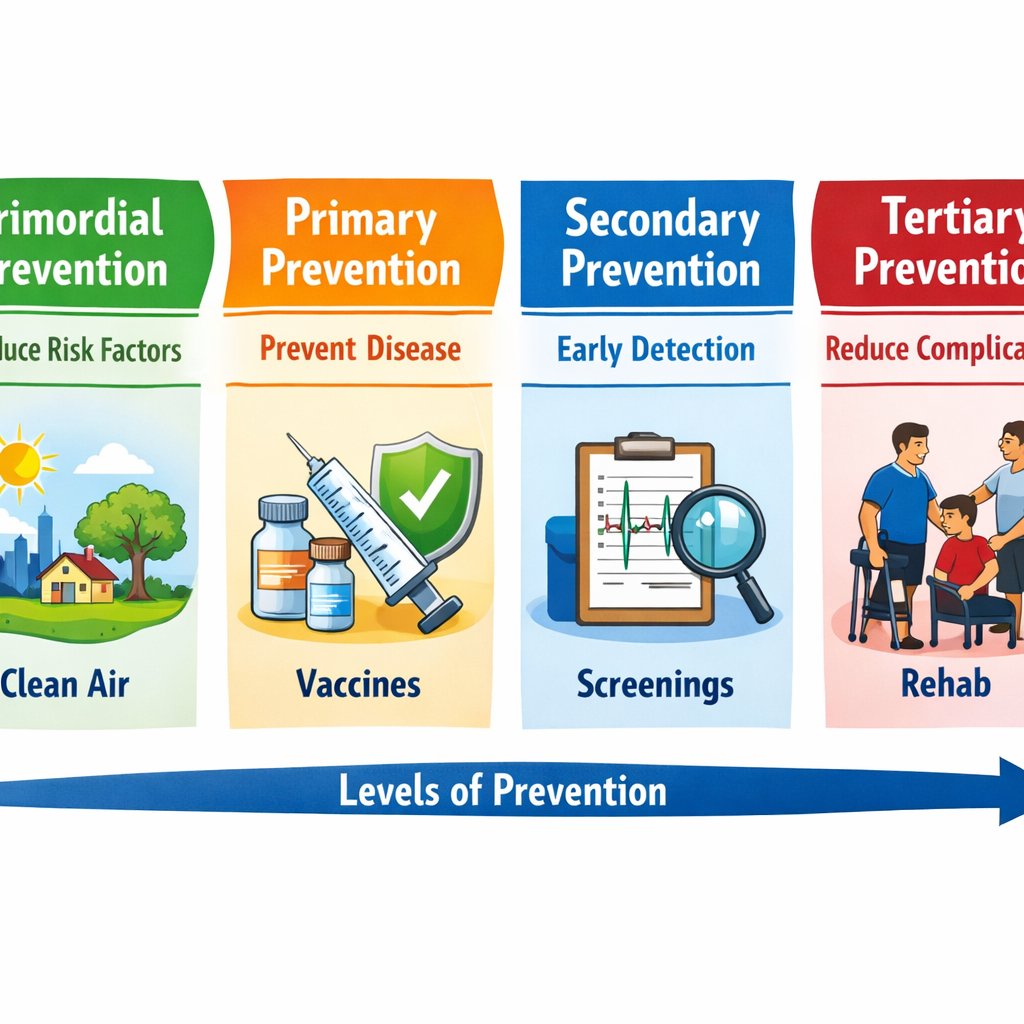
Preventive medicine organizes its interventions across four distinct levels, each targeting a different stage in the disease process. Understanding this framework is essential for clinicians, policymakers, and patients alike.
Primordial prevention addresses the root social, economic, and environmental conditions that give rise to risk factors in the first place. This is the most upstream form of prevention and includes efforts to combat air pollution, eliminate food deserts, improve housing quality, and ensure access to education. By shaping the conditions in which people live, primordial prevention seeks to prevent the emergence of risk factors like hypertension, obesity, or smoking initiation before they ever take hold.
Primary prevention intervenes before disease occurs by targeting established risk factors. Classic examples include childhood and adult vaccination programs, smoking cessation counseling, and the widely recommended 150 minutes of moderate-intensity exercise per week. Primary prevention also encompasses preventive medications such as statins for cholesterol management and antihypertensives for blood pressure control, which reduce the likelihood of a first heart attack or stroke.
Secondary prevention focuses on early detection of disease in its asymptomatic stages, when treatment is most effective and less invasive. Routine mammograms, colonoscopies, blood pressure screenings, and cholesterol panels all fall into this category. The goal is to identify disease before symptoms develop, enabling interventions that can halt progression and improve long-term outcomes.
Tertiary prevention addresses established disease with the aim of preventing complications, slowing progression, and preserving quality of life. Cardiac rehabilitation programs following a heart attack, diabetes self-management education, and physical therapy after a stroke are all tertiary prevention strategies. This level is sometimes omitted from simplified discussions of prevention, which has led to some confusion in public-facing content that references only primary and secondary types. In reality, tertiary prevention is indispensable for managing the growing burden of chronic disease in an aging population.
The Economic Impact: Why Preventive Medicine Saves Money
The economic case for preventive medicine is compelling, though it has often been underrepresented in public discourse. Concrete data demonstrates that investment in prevention yields substantial returns across the healthcare system.
Vaccination programs offer some of the clearest evidence. Studies consistently show that every dollar spent on childhood immunizations saves between three and ten dollars in direct medical costs by averting hospitalizations, emergency department visits, and long-term disability. Adult influenza vaccination similarly reduces workplace absenteeism and healthcare utilization. These returns compound when considering indirect costs such as lost productivity and caregiver burden.
Preventive screenings reduce hospital readmission rates and emergency department utilization by catching conditions before they escalate. A patient whose hypertension is identified and managed through routine primary care is far less likely to present in the emergency department with a stroke. Similarly, colorectal cancer detected at an early stage through screening costs a fraction of what advanced-stage treatment requires.
Preventive medications play a central role in this economic equation. Statins, antihypertensives, metformin for diabetes, and inhaled corticosteroids for asthma all work by controlling disease processes before they result in catastrophic and expensive events. Prenatal folic acid supplementation prevents neural tube defects, avoiding a lifetime of medical complexity and cost. These medications, when prescribed appropriately and taken consistently, represent some of the highest-value interventions in modern medicine.
The shift toward value-based care models, driven by the Centers for Medicare and Medicaid Services and Accountable Care Organizations, has further aligned financial incentives with prevention. Under these arrangements, providers are rewarded for keeping populations healthy rather than for the volume of services delivered. This makes preventive medicine not just a clinical imperative but a financial strategy for health systems.
The cost of inaction is equally instructive. Chronic diseases such as heart disease, diabetes, and cancer account for 90 percent of the nation's 4.1 trillion dollars in annual healthcare expenditures. Many of these conditions are preventable or manageable with early intervention. Without a robust preventive medicine infrastructure, these costs will continue to rise, straining public and private payers alike.
Preventive Medicine in Practice: Specialties and Career Paths
For physicians drawn to the field, preventive medicine offers a defined career pathway with multiple entry points. The route to board certification begins with a Doctor of Medicine (MD) or Doctor of Osteopathy (DO) degree, followed by a three-year residency in one of the preventive medicine specialties. Candidates then sit for the ABPM board examination. In 2023, the ABPM reported over 13,000 exam takers and more than 86 volunteers supporting the certification process, reflecting a growing interest in the specialty.
Aerospace medicine stands out as one of the most distinctive branches. Specialists in this field focus on the health and performance of flight crews and passengers, addressing the physiological challenges of altitude, acceleration, microgravity, and remote environments. These physicians may work with commercial airlines, military aviation units, or space agencies, applying preventive principles to extreme operational settings where a medical event can have catastrophic consequences.
Undersea and Hyperbaric Medicine represents another unique subspecialty. Physicians in this domain prevent and treat injuries related to increased ambient pressure environments, most notably diving accidents and decompression sickness. They also oversee hyperbaric oxygen therapy for conditions such as non-healing wounds, carbon monoxide poisoning, and radiation tissue injury. This niche combines environmental physiology with direct clinical application.
Occupational and Environmental Medicine physicians practice at the intersection of work and health. They design and evaluate workplace wellness programs, manage injury prevention initiatives, and address environmental exposures that contribute to disease. For employers, these specialists deliver measurable return on investment through reduced workers' compensation claims, lower absenteeism, and improved employee productivity.
Public Health and General Preventive Medicine practitioners often work in government agencies, academic institutions, or community organizations. Their scope includes policy development, epidemiological investigation, and the design of population-level interventions. These physicians may lead responses to disease outbreaks, develop screening guidelines, or advocate for policies that address the social determinants of health.
The Future of Preventive Medicine: Digital Health and Planetary Health
The future of preventive medicine is being shaped by two powerful forces: the rapid expansion of digital health technology and the growing recognition that human health is inseparable from the health of the planet.
Telemedicine and digital health tools are transforming the delivery of preventive services. Wearable devices that track heart rate, activity levels, and sleep patterns provide continuous data streams that can identify deviations from baseline before symptoms develop. Remote patient monitoring allows clinicians to manage chronic conditions like hypertension and diabetes between office visits, reducing gaps in care. Artificial intelligence algorithms are increasingly capable of assessing risk for conditions ranging from cardiovascular disease to cancer, enabling earlier and more targeted interventions. These technologies address one of the field's oldest challenges: the 1974 observation that motivating individuals to practice prevention is difficult. Digital tools offer reminders, incentives, and real-time feedback that make preventive behaviors more tangible and sustainable.
The social determinants of health lens has become central to preventive medicine research and practice. The journal Preventive Medicine explicitly prioritizes this framing, publishing work that examines how housing instability, food insecurity, educational attainment, and neighborhood conditions drive health outcomes. This perspective recognizes that clinical interventions alone cannot overcome the effects of adverse social conditions and that effective prevention must operate across multiple sectors.
Planetary health represents an emerging frontier that connects preventive medicine directly to environmental crises. The journal has issued a call for papers on "Preventing disease, promoting health and restoring the planet: Prevention and health promotion in the Anthropocene," linking climate change, biodiversity loss, and pollution to human disease prevention. Rising temperatures expand the range of vector-borne diseases. Air pollution contributes to respiratory and cardiovascular mortality. Extreme weather events disrupt healthcare access and supply chains. Preventive medicine, with its population-level perspective and focus on upstream causes, is uniquely positioned to address these intersections.
Age-specific prevention strategies are also gaining needed attention. Pediatric prevention emphasizes vaccination schedules, developmental screening, and the establishment of lifelong healthy behaviors. Geriatric prevention focuses on fall risk reduction, osteoporosis screening, cognitive assessment, and the management of polypharmacy. Both ends of the lifespan benefit from tailored approaches that account for changing physiology and risk profiles.
Frequently Asked Questions About Preventive Medicine
What is the difference between preventive medicine and public health?
Preventive medicine is a clinical specialty for physicians who complete residency training and board certification. Public health is a broader, multidisciplinary field that includes epidemiology, health education, environmental health, and policy. Preventive medicine physicians often work in public health settings, but the specialty includes clinical practice components that public health alone does not.
What are examples of preventive medications?
Common preventive medications include statins for high cholesterol, antihypertensives for blood pressure control, metformin for diabetes prevention or management, inhaled corticosteroids for asthma control, bisphosphonates for osteoporosis, and prenatal folic acid to prevent neural tube defects. These medications work by controlling risk factors or early disease processes before complications develop.
Is preventive medicine covered by insurance?
Under the Affordable Care Act, most health plans must cover a defined set of preventive services without cost-sharing when delivered by an in-network provider. This includes immunizations, cancer screenings, blood pressure and cholesterol checks, and annual wellness visits. Coverage for preventive medications varies by plan but is generally included in prescription drug benefits.
How do I become a preventive medicine specialist?
The path requires completion of medical school (MD or DO), a three-year residency in a preventive medicine specialty, and successful completion of the ABPM board examination. Some physicians enter preventive medicine after completing another residency, bringing dual specialization to their practice.
What is the impact factor of the Preventive Medicine journal?
The journal Preventive Medicine, founded in 1972 by Ernst Wynder, has an Impact Factor of 3.2 and a CiteScore of 8.3. Submission-to-decision after review averages 40 days, and acceptance-to-online publication takes approximately 2 days. The open access Article Publishing Charge is USD 3,910.
Conclusion: Embracing Prevention as the Standard of Care
The transition from a reactive, treatment-centered healthcare system to one built on proactive prevention is no longer aspirational. It is an economic necessity and a moral obligation. Preventive medicine provides the clinical framework, the evidence base, and the specialized workforce to lead this transformation. For healthcare professionals, exploring board certification in this field offers a career defined by impact at scale. For patients, scheduling a preventive visit and understanding covered services is a concrete next step. The case for prevention is clear: it saves lives, reduces suffering, and preserves resources. The challenge now is to build the systems, policies, and incentives that make prevention the standard of care rather than an afterthought.