

The Growing Importance of Remote Patient Monitoring in 2025: A Guide for Healthcare Providers
Remote patient monitoring has moved from experimental technology to a core pillar of value-based care, reshaping how providers manage chronic disease, allocate clinical staff, and capture reimbursement. For healthcare administrators and staffing managers, the shift is no longer theoretical. CMS reimbursements for RPM exploded from $5.5 million in 2019 to over $101 million in 2021, a 19-fold increase that signals permanent change in care delivery and payment models. This article provides a practical roadmap for understanding RPM’s clinical value, billing structure, staffing implications, and the unanswered questions that early adopters can turn into competitive advantage.
What Is Remote Patient Monitoring? A Modern Definition
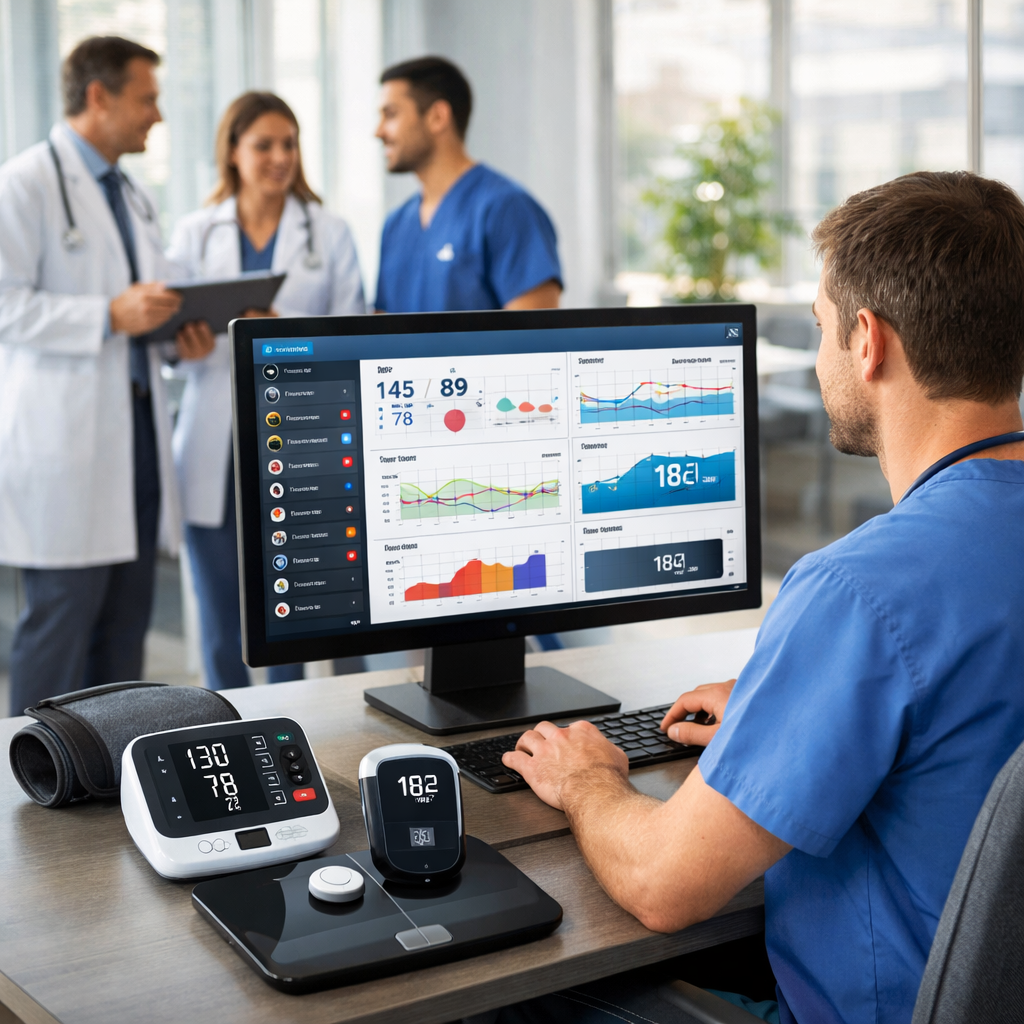
Remote patient monitoring is the use of FDA-approved digital devices to collect and transmit physiologic data from a patient’s home to a healthcare provider for clinical assessment and management. Common devices include blood pressure cuffs, continuous glucose monitors, pulse oximeters, smart scales, and heart rate monitors. The defining feature is not the device itself but the workflow: data flows from patient to provider on a continuous or periodic schedule, enabling clinical decisions without an office visit.
This distinguishes RPM from general telehealth. A video visit is a real-time encounter that ends when the call disconnects. RPM, by contrast, generates an ongoing stream of information that requires systematic review, documentation, and response. CMS recognizes this distinction through a three-part billing framework. First, providers bill for patient education and device setup. Second, they bill for device supply, which requires a minimum of 16 readings transmitted every 30 days. Third, they bill for treatment and management services, which cover the clinical time spent reviewing data and adjusting care plans. Every device used in an RPM program must meet the FDA’s definition of a medical device and must digitally upload data, not simply display readings on a screen.
Why RPM Matters Now: Reimbursement and Regulatory Tailwinds
The Medicare and Medicaid Shift
Medicare began covering remote patient monitoring in 2018, and patient enrollment has increased significantly each year since. The financial trajectory tells the story: CMS reimbursements grew from $5.5 million in 2019 to more than $101 million in 2021. That 19-fold increase reflects both expanded patient access and growing provider confidence in the billing pathway. For healthcare organizations still sitting on the sidelines, the reimbursement infrastructure is no longer experimental. It is established, codified, and growing.
Medicaid programs have followed suit, though with more variation. As of March 2023, 34 state Medicaid programs covered RPM services. However, many impose restrictions on which device types qualify, which conditions are eligible, and which provider types can bill. Organizations operating across state lines must verify the specific rules in each jurisdiction, as a program that works under one state’s Medicaid plan may not be reimbursable under another’s.
The COVID-19 Acceleration
The pandemic compressed years of regulatory caution into months of urgent adoption. When in-person visits became infection risks, RPM emerged as a critical tool for managing hypertension, diabetes, congestive heart failure, COPD, and asthma without exposing vulnerable patients to the virus. Regulators loosened restrictions on telehealth and remote monitoring, and many of those flexibilities have since been made permanent or extended. The cultural shift among both patients and providers may prove even more durable than the regulatory changes. Patients who learned to use a home blood pressure cuff during the pandemic are unlikely to see the value in returning to clinic-only measurements.
Key Benefits of Remote Patient Monitoring for Providers and Patients
Clinical and Operational Wins
The clinical logic of RPM is straightforward: continuous data reveals patterns that episodic office readings miss. A patient with congestive heart failure who gains three pounds overnight is in trouble. A single weight check at a monthly appointment will not catch that. Daily smart scale readings will. Similarly, blood pressure trends over weeks provide a far richer picture for medication titration than a single in-clinic reading, which may be elevated by the stress of the visit itself.
This early detection capability translates directly into operational benefits. Fewer acute decompensations mean fewer emergency department visits and hospital readmissions. Fewer routine check-ins that require physical presence mean clinic schedules can be reserved for patients who truly need hands-on care. Patient engagement improves when individuals see their own data and understand how their daily choices affect their numbers. The feedback loop between behavior and biometrics becomes immediate and personal.
Addressing the Gaps: What the Data Doesn’t Yet Show
An honest assessment requires acknowledging what the published literature has not yet delivered. While the benefits of RPM are widely cited, specific clinical outcome statistics remain surprisingly sparse in public data. Reductions in hospital readmission rates, improvements in A1C levels, and blood pressure control percentages are frequently claimed but less frequently quantified in peer-reviewed studies with rigorous controls. This is not evidence that RPM fails to produce these outcomes. It is evidence that the implementation has outpaced the research.
For providers, this gap represents an opportunity. Organizations that build internal tracking into their RPM programs, measuring readmission rates, patient adherence, and clinical endpoints from day one, will generate the ROI data that payers and partners increasingly demand. Patient satisfaction and adherence rates are similarly underreported, leaving room for early adopters to define benchmarks and establish thought leadership.
Who Qualifies for RPM? Patient and Device Requirements
Patient eligibility for remote patient monitoring rests on three pillars. First, the patient must have a chronic or acute condition that requires monitoring. The most common qualifying conditions include hypertension, diabetes, COPD, asthma, congestive heart failure, and post-surgical recovery. Second, an established provider-patient relationship must exist. For new patients, Medicare requires an in-person exam before RPM enrollment can begin, a compliance detail that organizations sometimes overlook when designing direct-to-patient marketing. Third, the patient must use a device that meets the FDA’s definition of a medical device and digitally uploads physiologic data to the provider.
The device requirement deserves careful attention. Not every consumer wearable qualifies. A smartwatch that tracks steps is not necessarily an FDA-approved medical device, even if it also measures heart rate. Providers must ensure that the specific device prescribed for RPM meets regulatory standards and transmits data in a format compatible with their monitoring platform.
One practical barrier that deserves more attention is internet access. Many RPM programs assume patients have reliable broadband at home. Johns Hopkins Care at Home has addressed this directly by providing devices with built-in cellular network connections, eliminating the need for patient home internet. This model is particularly relevant for rural, elderly, and low-income populations, where broadband access cannot be assumed. Organizations designing RPM programs for underserved communities should evaluate cellular-enabled devices as a core requirement, not an optional upgrade.
Implementing an RPM Program: Challenges and Best Practices
Common Implementation Barriers
The most frequently underestimated challenge in RPM implementation is clinician workload. A program that generates continuous data requires continuous triage. Without dedicated staff to review incoming readings, flag abnormal values, and escalate urgent findings, the data stream becomes noise, or worse, a liability. Oracle Health has noted that clinician burnout is a real risk when RPM data flows into an inbox that is already overflowing. Organizations that simply add RPM review to existing nursing or physician workloads without adjusting expectations or staffing levels are setting themselves up for failure.
Data privacy and HIPAA compliance represent a second major barrier. Every device, transmission pathway, and storage platform in the RPM workflow must meet HIPAA standards. A data breach involving home monitoring data carries the same regulatory and reputational consequences as a breach of in-clinic records. The legal risks extend beyond HIPAA. Malpractice liability questions remain unsettled in many jurisdictions. If a provider receives an abnormal reading but does not act on it in time, what is the standard of care? These questions are still being litigated and legislated.
Patient dropout is a third persistent challenge. Adherence rates fall when patients are not properly educated during the setup phase. If a patient does not understand why daily readings matter, or finds the device cumbersome, or simply forgets, the program fails. Education at setup is not a one-time checkbox. It requires ongoing reinforcement, and it requires staff time.
Staffing Considerations for Healthcare Organizations
Effective RPM programs require dedicated monitoring personnel. The Mayo Clinic’s heart rhythm monitoring laboratory offers one model: technicians monitor incoming data in real time and respond to unusual readings immediately, escalating to clinicians only when necessary. This command center approach separates data triage from clinical decision-making, preserving physician and advanced practice provider time for the cases that truly require their expertise.
For organizations like Healthcare Staffing Plus, this staffing need creates a direct demand signal. RPM programs require remote monitoring technicians who can review data streams, flag abnormalities, and follow escalation protocols. They require telehealth nurses who can conduct follow-up calls when readings are concerning. They require data coordinators who can ensure that billing documentation meets the 16-reading minimum and other CMS requirements. These roles are relatively new, and the talent pool is still developing. Organizations that build recruitment pipelines for RPM-specific roles now will have an advantage as demand accelerates.
The “bring your own device” model, discussed by Oracle Health, offers a partial staffing offset. When patients use their own smartphones and compatible wearables, equipment costs drop and patient familiarity increases. However, this approach shifts complexity to the IT and support side, requiring staff who can troubleshoot device compatibility and data transmission issues across a wider range of hardware.
The Future of RPM: Policy, Clinical Trials, and Rural Access
Policy momentum continues to build. The Bipartisan Policy Center has issued recommendations that include data privacy safe harbors for providers acting in good faith, cybersecurity standards for connected devices, and EHR interoperability requirements that would make RPM data more portable across platforms. These recommendations are not yet law, but they signal the direction of travel. Providers who align their RPM programs with these emerging standards now will face less disruption when regulations formalize.
The application of RPM to clinical trials represents a less visible but potentially transformative shift. Oracle Health has positioned RPM as foundational for virtual, home-based clinical trials, noting that remote monitoring can improve recruitment diversity by removing the geographic barriers that exclude rural and low-income participants. Faster trial results and more representative data could accelerate drug development and expand the evidence base for RPM itself.
Rural and underserved populations stand to gain the most from RPM, but only if programs are designed with their specific barriers in mind. Cellular-enabled devices address the internet access problem. Health literacy considerations must shape patient education materials and workflows. Language access is equally critical. The Joint Commission accreditation that Johns Hopkins highlights for its Care at Home program may become a quality differentiator as RPM programs proliferate and patients, referring physicians, and payers look for signals of program quality.
Frequently Asked Questions About Remote Patient Monitoring
Is remote patient monitoring covered by Medicare? Yes, Medicare has covered RPM since 2018. The program reimburses providers for device supply, patient education and setup, and treatment management services under specific billing codes, provided the patient transmits at least 16 readings every 30 days using an FDA-approved device.
What training is needed for RPM? No single RPM-specific certification exists yet, though this may change as the field matures. Currently, relevant credentials include certifications in telehealth, healthcare informatics, clinical monitoring, and care coordination. Organizations hiring for RPM roles should look for a combination of clinical judgment, comfort with technology platforms, and experience with protocol-driven triage.
What is the best example of RPM? Hypertension management using remote blood pressure cuffs is the most widely cited example, allowing medication titration based on weeks of home readings rather than single office measurements. Weight monitoring for congestive heart failure patients and continuous glucose monitoring for diabetes are similarly well-established use cases with clear clinical rationales.